Class 12 Maths
Integrals

Definite Integral
A definite integral is denoted by aʃb f(x) dx, where a is called the lower limit of the integral and b is called the upper limit of the integral. The definite integral is introduced either as the limit of a sum or if it has an anti derivative F in the interval [a, b], then its value is the difference between the values of F at the end points, i.e., F(b) - F(a).
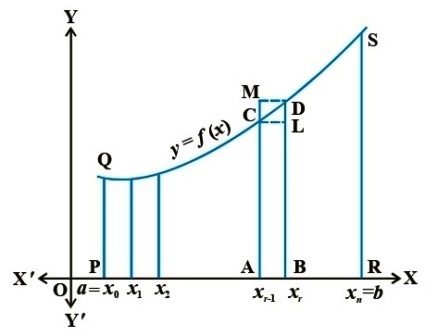
Definite integral as the limit of a sum:
The definite integral aʃb f(x) dx is the area bounded by the curve y = f (x), the ordinates x = a, x = b and the x-axis. To find this area Let us consider the region PQRSP between this curve and the ordinates x = a and x = b as shown in the given figure.
Now, divide the interval [a, b] into n equal sub intervals denoted by [x0, x1], [x1, x2], ……..,[xr-1, xr], ………..
[xn-1, xn] where x0 = a, x1 = a + h, x2 = a + 2h, ……….,xr = a + rh, xn = b = a + nh or h = (b - a)/n
Again as n -> ∞, h -> 0
The region PRSQP under consideration is the sum of n sub regions, where each sub region is defined on sub intervals [xr – 1, xr], r = 1, 2, 3, …, n.
Now, to find the area of the region PQRSQ is calculated as
Limx->∞ Sn = area of the region PQRSQ = aʃb f(x) dx
= limh->0 h[f(a) + f(a + h) + ………….+ f{a + (n - 1)h}]
= (b - a) * limh->∞ (1/n)[f(a) + f(a + h) + ………….+ f{a + (n - 1)h}]
So, aʃb f(x) dx = (b - a) * limh->∞ (1/n)[f(a) + f(a + h) + ………….+ f{a + (n - 1)h}]
Where h = (b - a)/n as n -> ∞
This is known as the definition of definite integral as the limit of sum.
Problem: Evaluate the definite integral as limit of sums
ʃ05 (x + 1) dx
Solution:
We know that
ʃab f(x) dx = (b - a)limn->∞ (1/n)[f(a) + f(a + h) + …………..+ f{a + (n - 1)h}], where h = (b - a)/n
Here a = 0, b = 5 and f(x) = x + 1
So, h = (5 - 0)/n = 5/n
Now, ʃ05 (x + 1) dx = (5 - 0)* limn->∞ (1/n)[f(0) + f(5/h) + …………..+ f{5(n - 1)/n}]
= 5 * limn->∞ (1/n)[1 + (5/n + 1) + …………..+ {1 + 5(n - 1)/n}]
= 5 * limn->∞ (1/n)[(1 + 1 + 1 + …….n times) + {5/n + 2 * 5/n + …………..+ 5(n - 1)/n}]
= 5 * limn->∞ (1/n)[(1 + 1 + …….n times) + (5/n){1 + 2 + 3 +…………..+ (n - 1)}]
= 5 * limn->∞ (1/n)[n + (5/n) * n(n - 1)/2]
= 5 * limn->∞ (1/n)[n + 5(n - 1)/2]
= 5 * limn->∞ (n/n)[1 + 5(1 – 1/n)/2]
= 5 * [1 + 5(1 – 1/∞)/2]
= 5 * [1 + 5(1 – 0)/2]
= 5 * [1 + 5/2]
= 5 * (7/2)
= 35/2
Class 12 Maths Integrals NCERT Chapter 7 Free Notes for Best Revision
Revision of Class 12 Maths Integrals is a crucial aspect of effective learning. Revision plays a vital role in the learning process and is especially important before exams. Here are some key points you can consider emphasizing in your content:
- Retention and Memory: Regularly reviewing and revisiting the material of Class 12 Maths Integrals helps reinforce the concepts in students' minds. It strengthens memory pathways, making it easier to recall information during exams and beyond.
- Consolidation of Knowledge: When you revise notes, you are essentially consolidating your knowledge. This means connecting new information with what you already know, making the overall understanding more robust.
- Identifying Knowledge Gaps: Revision allows students to identify any gaps in their understanding or areas where they need further clarification. This gives you a chance to seek help or delve deeper into those topics. For detailed understanding, you can always refer to the videos of Integrals Class 12 Maths NCERT Chapter 7 on LearnoHub.com
- Building Confidence: As you revise Integrals Class 12 Maths and become more familiar with the content, your confidence in your abilities grows. Confidence is a crucial factor in exam performance as it reduces anxiety and allows you to approach exams with a positive mindset.
- Different Revision Techniques: Use a variety of revision techniques such as summarizing notes, creating flashcards, practicing past papers, discussing concepts with peers, and teaching others. Different techniques work for different students, and it's essential to find what suits you the best. You can also attend the LIVE Revision classes on LearnoHub.com or watch the LIVE Revision Race videos of LearnoHub on Integrals Class 12 Maths NCERT Chapter 7.
- Spacing Effect: Spacing out revision sessions over time, rather than cramming all at once, has been shown to improve long-term retention. Create a revision schedule leading up to the exams to allow for spaced practice.
- Regular Revision over Cramming: Regular and consistent revision throughout the academic year is very important. Waiting until the last moment to cram everything can be overwhelming and less effective than spaced-out revision.
- Self-Assessment: Assess your understanding periodically through quizzes or self-tests. This helps you to gauge your progress and identify areas that need further attention. Refer Class 12 Integrals Online Tests.
- Balanced Approach: Remind students to strike a balance between revision and other activities. Adequate rest, exercise, and relaxation are essential for optimal learning and performance.
- Seeking Help: If you face difficulties during the revision process, Refer the videos of Class 12 Maths Integrals. Clearing doubts promptly is crucial for a better grasp of the subject matter. You can always ask your doubts on Integrals Class 12 Maths NCERT Chapter 7. “Ask a Question” section of LearnoHub.com
By highlighting the benefits and strategies of effective revision, you can approach your studies more mindfully and achieve better results in your exams. Best of luck bachhon!
Class 12 Maths seems to be a quite difficult subject for a lot of students. But, if you get a very good conceptual understanding of the subject, it can be very interesting for you.
We, at LearnoHub, will give our best to make Class 12 Maths Integrals NCERT Chapter 7 super-duper easy for you.
We aim at making learning fun as well as engaging for you with our complete end-end learning content with Integrals Class 12 Maths Best videos, Notes, NCERT pdf, NCERT complete syllabus, tests and Practice Questions.
Always remember, it is very important to study with full concentration during Revision. Here are a few tips for you on how to revise with full focus:
- Create a Distraction-Free Environment: Find a quiet and comfortable place to study where you can minimize distractions. Turn off or silence your phone, log out of social media accounts, and inform others around you that you need uninterrupted study time. A dedicated study environment will help you focus better.
- Set Specific Goals: Before starting your study session, set clear and achievable goals. Break down your study material into smaller tasks, and plan what you want to accomplish during each session. Having specific goals will give you a sense of direction and purpose, making it easier to concentrate.
- Use the Pomodoro Technique: The Pomodoro Technique is a time management method that involves studying in short, focused intervals, typically 25 minutes, followed by a short break of 5 minutes. After completing four sessions, take a longer break of around 15-30 minutes. This technique can improve focus and productivity by providing regular breaks to recharge.
- Stay Organized: Keep your study materials, notes, and resources well-organized. Having everything you need at hand will save time and reduce distractions caused by searching for materials. Use color-coded folders or digital tools to maintain a structured study system.
- Practice Mindfulness and Meditation: Before you begin studying, take a few minutes to practice mindfulness or meditation. Deep breathing exercises and clearing your mind of distractions can help you approach your study session with a calm and focused mindset.
Remember, studying with full concentration is a skill that takes time and practice to develop. If you find your mind wandering during study sessions, gently bring your focus back to the task at hand and be patient with yourself. With consistent effort, you can improve your ability to concentrate and make the most of your study time.
Last but not the least, To get the best hold on Class 12 Maths Integrals Book Chapter 7. Do not forget to check out:
- Integrals Class 12 Maths Best videos
- Integrals Class 12 Maths NCERT Solutions
- Class 12 Maths Integrals Revision notes
- Integrals Class 12 Maths DPPS, Download PDF of solutions
- Class 12 Maths Integrals Online Tests
- Class 12 Maths Sample papers