NCERT Solutions
Class 10 Maths
Circles

Ex.10.2 Q.12
A triangle ABC is drawn to circumscribe a circle of radius 4 cm such that the segments BD and DC into
which BC is divided by the point of contact D are of lengths 8 cm and 6 cm respectively (see Fig. 10.14).
Find the sides AB and AC.
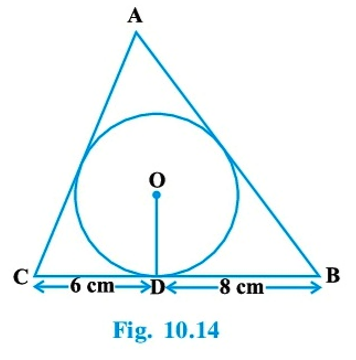
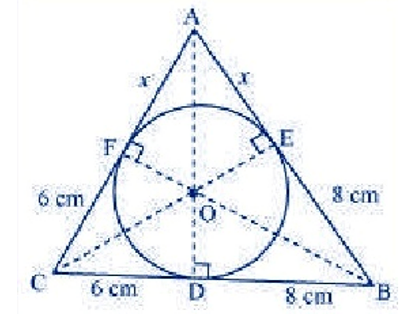
Let the given circle touch the sides AB and AC of the triangle at point E and F respectively
and the length of the line segment AF be x.
In ΔABC,
CF = CD = 6cm
(Tangents on the circle from point C)
BE = BD = 8cm
(Tangents on the circle from point B)
AE = AF = x
(Tangents on the circle from point A)
AB = AE + EB = x + 8
BC = BD + DC = 8 + 6 = 14
CA = CF + FA = 6 + x
Now, 2s = AB + BC + CA
= x + 8 + 14 + 6 + x
= 28 + 2x
=> s = 14 + x
Area of ΔABC = √ {s (s - a) (s - b) (s - c)}
= √ [(14 + x) {14 + x - 14} {(14 + x) – (6 + x)} {(14 + x) – (8 + x)}]
= √ [(14 + x) × x × 8 × 6]
= 4√ [3(14x + x2)]
Area of ΔOBC =  × OD × BC
= × 4 × 14
= 28
Area of ΔOCA = × OF × AC
= × 4 × (6 + x)
= 2 × (6 + x)
= 12 + 2x
Area of ΔOAB = × OE × AB
= × 4 × (8 + x)
= 2 × (8 + x)
= 16 + 2x
Now, Area of ∆ABC = Area of ∆OBC + Area of ∆OCA + Area of ∆OAB
=> 4√ [3(14x + x2)] = 28 + 12 + 2x + 16 + 2x
=> 4√ [3(14x + x2)] = 56 + 4x
=> 4√ [3(14x + x2)] = 4(14 + x)
=> √ [3(14x + x2)] = 14 + x
Squaring on both sides, we get
=> 3(14x + x2) = (14 + x)2
=> 42x + 3x2 = 196 + x2 + 28x
=> 42x + 3x2 - 196 - x2 - 28x = 0
=> 2x2 + 14x – 196 = 0
=> x2 + 7x – 98 = 0
=> x2 + 14x - 7x - 98 = 0
=> x (x + 14) – 7(x + 14) = 0
=> (x - 7) (x + 14) = 0
=> x = 7, -14
Here, x = -14 is not possible as the length of the sides will be negative.
So, x = 7
Hence, AB = x + 8 = 7 + 8 = 15 cm
CA = 6 + x = 6 + 7 = 13 cm