Daily Practice Problems
ICSE 6 History
The Chinese Civilisation
ICSE 6 History
The Chinese Civilisation

Question 1:
Choose the correct option. [Level: Easy to Difficult]
1. Which river is called the “Cradle of Chinese Civilization”?
A) Yangtze
B) Mekong
C) Huang He
D) Ganga
2. The Great Wall of China was first linked into one long structure by which dynasty?
A) Shang
B) Zhou
C) Qin
D) Han
3. Which Chinese invention most changed sea navigation?
A) Seismograph
B) Gunpowder
C) Compass
D) Wheelbarrow
4. The idea of the “Mandate of Heaven” was introduced by which dynasty?
A) Shang
B) Qin
C) Han
D) Zhou
5. Porcelain was perfected during which dynasty?
A) Shang
B) Han
C) Tang/Song
D) Ming
Question 2:
State true or false. [Level: Easy to Difficult]
1. Traditional Chinese houses usually had south-facing entrances.
2. Gunpowder was invented during the Shang dynasty.
3. Pagodas were used mainly as military watch towers.
4. Zhang Heng invented the first earthquake detector (seismograph).
5. The secret of silk-making was known across Europe by 500 BCE.
Question 3:
Fill in the Blanks. [Level: Easy to Moderate]
1. Ancient Chinese homes were built around a central open space called a __________.
2. The Chinese calendar divided the year into __________ months.
3. The art of raising silkworms to make silk is known as __________.
4. Chinese priests used __________ to ask questions to the gods.
5. Zhang Heng's __________ worked by dropping balls from dragon mouths to show the direction of a quake.
Question 4:
Assertion–Reason. [Level: Difficult]
Assertion: Zhou cities were built using a 9-square grid pattern.
Reason: The design followed feng shui and astronomy to show harmony between Heaven, Earth, and Man.
A) Both A and R are true, and R explains A.
B) Both A and R are true, but R does not explain A.
C) A is true, R is false.
D) A is false, R is true.
Question 5:
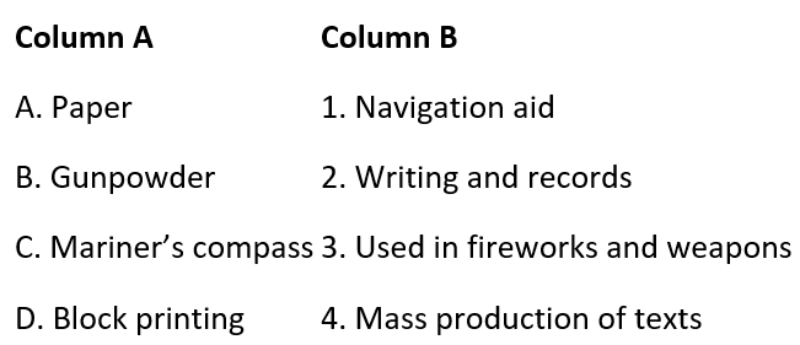
Match Column A with Column B. [Level: Moderate]
Question 6:
Why did early Chinese farmers continue to live near the Huang He River even though it often flooded dangerously? [Level: Moderate]
Question 7:
Name two inventions made by ancient Chinese people and explain their importance. [Level: Easy]
Question 8:
Read the case below and answer the questions: [Level: Difficult]
A trader from ancient China packs silk, paper, and porcelain in a caravan. He travels across mountains and deserts toward the Middle East to exchange these goods for horses and jewels.
a) What was the name of this trade route?
b) Why was Chinese silk in high demand?
c) Name one region the Chinese traded with.
d) What is one cultural idea that may have come to China through this trade?
Question 9:
Explain the architectural achievements of ancient China. What do they tell us about the Chinese civilization? [Level: Moderate]
Question 10:
Why is Chinese civilization known as one of the world’s oldest continuous civilizations? Support your answer with examples. [Level: Difficult]
**********
In summary, problem-solving after learning a theoretical concept on CBSE The Chinese Civilisation ICSE 6 History is an essential part of the learning process. It enhances your understanding, critical thinking abilities, and retention of knowledge. Moreover, it equips you with valuable skills that are applicable in academic, personal, and professional contexts.
You must have heard of the phrase “Practice makes a man perfect”. Well, not just a man, practice indeed enhances perfection of every individual.
Practicing questions plays a pivotal role in achieving excellence in exams. Just as the adage goes, "Practice makes perfect," dedicating time to solve a diverse range of exam-related questions yields manifold benefits. Firstly, practicing questions allows students to familiarize themselves with the exam format and types of problems they might encounter. This familiarity instills confidence, reducing anxiety and improving performance on the actual exam day. Secondly, continuous practice sharpens problem-solving skills and enhances critical thinking, enabling students to approach complex problems with clarity and efficiency. Thirdly, it aids in identifying weak areas, allowing students to focus their efforts on improving specific topics. Moreover, practice aids in memory retention, as active engagement with the material reinforces learning. Regular practice also hones time management skills, ensuring that students can allocate appropriate time to each question during the exam. Overall, practicing questions not only boosts exam performance but also instills a deeper understanding of the subject matter, fostering a holistic and effective learning experience.
All About Daily Practice Problems on ICSE 6 History The Chinese Civilisation NCERT Chapter 4
Our Daily Practice Problems (DPPs) offer a diverse range of question types, including Multiple Choice Questions (MCQs) as well as short and long answer types. These questions are categorized into Easy, Moderate, and Difficult levels, allowing students to gradually progress and challenge themselves accordingly. Additionally, comprehensive solutions are provided for each question, available for download in PDF format - Download pdf solutions as well as Download pdf Questions. This approach fosters a holistic learning experience, catering to different learning styles, promoting self-assessment, and improving problem-solving skills. With our well-structured DPPs, students can excel in exams while gaining a deeper understanding of the subject matter. Hope you found the content on ICSE 6 History The Chinese Civilisation NCERT Chapter 4 useful.
Last but not least, to get the best hold on ICSE 6 History The Chinese Civilisation NCERT Chapter 4, do not forget to check out: