Daily Practice Problems
Class 12 Biology
Human Reproduction
Class 12 Biology
Human Reproduction

Question 1:
Give the scientific terms for the following:
1. The first menstruation that marks the onset of puberty in females.
2. The period between the time of conception and birth during which the embryo or foetus develops within the uterus.
3. The process of expulsion of a fully developed foetus out of the uterus through the birth canal.
4. The milk produced during the initial few days of lactation.
5. The process by which the blastocyst gets embedded in the inner lining of the uterus.
Question 2:
Fill in the blanks:
1. Each seminiferous tubule is lined on its inside by two types of cells called __________ and __________.
2. __________ is a process by which the spermatids are differentiated into the spermatozoa.
3. __________ is a cap-like structure present at the anterior end of the sperm.
4. __________ are finger-like projections that appears on the trophoblast and interdigitates with the uterine tissue to form the placenta.
5. The region of the fallopian tube where fertilisation occurs is called __________.
Question 3:
State the functions associated with the following:
1. Leydig cells
2. Sertoli cells
3. Corpus luteum
4. Acrosome
5. Oxytocin hormone
Question 4:
Define the following terms:
1. Ovulation
2. Lactation
3. Menopause
4. Spermatogenesis
5. Spermiogenesis
Question 5:
State whether the following statements are true or false.
1. Failure of testes to descend into scrotal sacs leads to sterility.
2. The expulsion of completely developed foetus from the uterus is called gestation.
3. First half of the menstrual cycle is controlled by progesterone while its second half is controlled by estrogen.
4. Sexual reproduction always involves gametic fusion.
5. The placenta is connected to the embryo through an umbilical cord.
Question 6:
Arrange the following in correct order:
Mammary duct, lacticiferous duct, alveoli, ampulla, mammary lobes
Question 7:
Give reasons for the following statements.
1. In males, the testes lie outside the abdominal cavity.
2. Oogenesis is considered to be a highly wasteful process.
3. Placenta is also considered as a physiological connection between the mother and the foetus.
4. The second half of the menstrual cycle is called luteal phase as well as secretory phase.
5. Menstruation does not occur before pregnancy, after menopause and during pregnancy period.
Question 8:
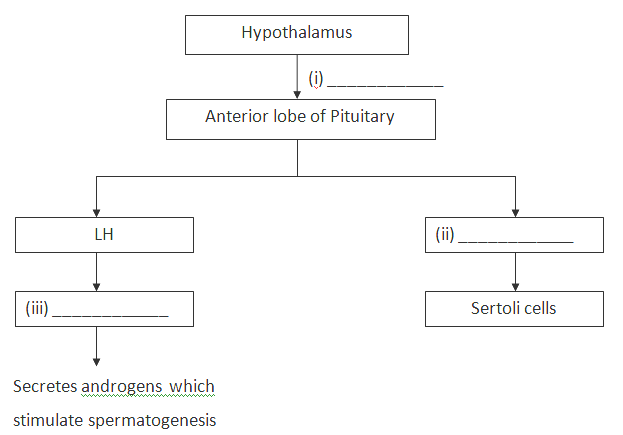
Complete the following flowchart that depicts the hormonal control of spermatogenesis in humans.
Question 9:
Draw a well labelled diagram of the sectional view of a seminiferous tubule.
Question 10:
Give a schematic representation of Oogenesis in females. Also mention the chromosome number per cell at each stage.
Question 11:
Match the columns A and B.
|
Column A |
Column B |
|
1. Morula |
a. Mature follicle |
|
2. Trophoblast |
b. Pregnancy period |
|
3. Gestation |
c. Childbirth |
|
4. Parturition |
d. 8 to 16- celled |
|
5. Graafian follicle |
e. Implantation |
Question 12:
Give a brief account of sex determination in human beings.
Question 13:
Draw a neat labelled diagram of a sectional view through a mammalian ovary.
Question 14:
List down the important functions associated with placenta.
Question 15:
Draw a well labelled diagram of a human sperm.
Question 16:
Given below is a diagram of the human male reproductive system. Study the same and answer the questions that follow:

(i) Label the parts 1 to 5.
(ii) State the functions associated with part 3 and 4.
(iii) Which among the parts 1 to 5 is considered as the site of sperm formation?
(iv) What is the term given to the duct formed by the union of vas deferens with duct of seminal vesicle?
Question 17:
State the composition of seminal plasma.
Question 18:
Draw a labelled diagram of a mature ovarian follicle.
Question 19:
Given below is a diagrammatic sectional view of the female reproductive system. Study the figure carefully and answer the questions that follow:

(i) Label the parts 1 to 5.
(ii) Name the part which is considered to be the site of fertilisation.
(iii) Identify the part where the implantation of the blastocyst takes place.
(iv) Give any two functions associated with part labelled 2.
Question 20:
Give a brief account of the role of various hormones during menstrual cycle.
**********
In summary, problem-solving after learning a theoretical concept on CBSE Human Reproduction Class 12 Biology is an essential part of the learning process. It enhances your understanding, critical thinking abilities, and retention of knowledge. Moreover, it equips you with valuable skills that are applicable in academic, personal, and professional contexts.
You must have heard of the phrase “Practice makes a man perfect”. Well, not just a man, practice indeed enhances perfection of every individual.
Practicing questions plays a pivotal role in achieving excellence in exams. Just as the adage goes, "Practice makes perfect," dedicating time to solve a diverse range of exam-related questions yields manifold benefits. Firstly, practicing questions allows students to familiarize themselves with the exam format and types of problems they might encounter. This familiarity instills confidence, reducing anxiety and improving performance on the actual exam day. Secondly, continuous practice sharpens problem-solving skills and enhances critical thinking, enabling students to approach complex problems with clarity and efficiency. Thirdly, it aids in identifying weak areas, allowing students to focus their efforts on improving specific topics. Moreover, practice aids in memory retention, as active engagement with the material reinforces learning. Regular practice also hones time management skills, ensuring that students can allocate appropriate time to each question during the exam. Overall, practicing questions not only boosts exam performance but also instills a deeper understanding of the subject matter, fostering a holistic and effective learning experience.
All About Daily Practice Problems on Class 12 Biology Human Reproduction NCERT Chapter 2
Our Daily Practice Problems (DPPs) offer a diverse range of question types, including Multiple Choice Questions (MCQs) as well as short and long answer types. These questions are categorized into Easy, Moderate, and Difficult levels, allowing students to gradually progress and challenge themselves accordingly. Additionally, comprehensive solutions are provided for each question, available for download in PDF format - Download pdf solutions as well as Download pdf Questions. This approach fosters a holistic learning experience, catering to different learning styles, promoting self-assessment, and improving problem-solving skills. With our well-structured DPPs, students can excel in exams while gaining a deeper understanding of the subject matter. Hope you found the content on Class 12 Biology Human Reproduction NCERT Chapter 2 useful.
Last but not least, to get the best hold on Class 12 Biology Human Reproduction NCERT Chapter 2, do not forget to check out: