Question:
An electron emitted by a heated cathode and accelerated through a potential difference of 2.0 kV, enters a region with uniform magnetic field of 0.15 T. Determine the trajectory of the electron if the field (a) is transverse to its initial velocity, (b) makes an angle of 30degree with the initial velocity.
Answer:
Magnetic field strength, B = 0.15 T
Charge on the electron, e = 1.6 × 10 – 19 C
Mass of the electron, m = 9.1 × 10 – 31 kg
Potential difference, V = 2.0 kV = 2 × 10³ V
Thus, kinetic energy of the electron = eV

 ………………(1)
Where,
v = velocity of the electron
(a) Magnetic force on the electron provides the required centripetal force of the electron. Hence, the electron traces a circular path of radius r.
Magnetic force on the electron is given by the relation,
B ev
Centripetal force 

 …………….(2)
From equations (1) and (2), we get
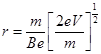



= 1 mm
Hence, the electron has a circular trajectory of radius 1.0 mm normal to the magnetic field.
(b) When the field makes an angle θ of 30° with initial velocity, the initial velocity will be,

From equation (2), we can write the expression for new radius as: 



= 0.5 mm
Hence, the electron has a helical trajectory of radius 0.5 mm along the magnetic field direction.
Not what you are looking for? Go ahead and submit the question, we will get back to you.