
Question:
please explain me the potential energy of a dipole in an external field
Answer: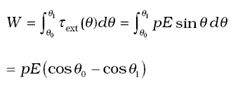
Consider a dipole with charges q1 = +q and q2 = –q placed in a uniform electric field E. In a uniform electric field, the dipole experiences no net force; but experiences a Torque =p×E (which will tend to rotate it (unless p is parallel or anti-parallel to E). Suppose an external torque  ext is applied in such a manner that it just neutralizes this torque and rotates it in the plane of paper from angle θ0 to angle θ1 at an infinitesimal angular speed and without angular acceleration. The amount of work done by the external torque will be given by
This work is stored as the potential energy of the system. A natural choice is to take θ0 = π / 2. We can then write,
Here, r1 and r2 denote the position vectors of +q and –q. Now, the potential difference between positions r1 and r2 equals the work done in bringing a unit positive charge against field from r2 to r1. The displacement parallel to the force is 2a cosθ. Thus, [V (r1)–V (r2)] = –E × 2a cosθ. We thus obtain,
Not what you are looking for? Go ahead and submit the question, we will get back to you.
