Question:
Whenever a reaction between an oxidising agent and a reducing agent is carried out, a compound of lower oxidation state is formed if the reducing agent is in excess and a compound of higher oxidation state is formed if the oxidising agent is in excess. Justify this statement giving three illustrations.
Answer:
Whenever a reaction between an oxidising agent and a reducing agent is carried out, a compound of lower oxidation state is formed if the reducing agent is in excess and a compound of higher oxidation state is formed if the oxidising agent is in excess. This can be illustrated as follows:
(i) are reducing and oxidising agents respectively.
If an excess of  is treated with
 , then
  will be produced, wherein the oxidation number (O.N.) of P is +3.
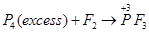
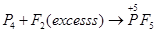
However, if is treated with an excess of , then  will be produced, wherein the O.N. of P is +5.
(ii)K acts as a reducing agent, whereas  is an oxidising agent.
If an excess of K reacts with , then  will be formed, wherein the O.N. of O is -2.

However, if K reacts with an excess of , then  will be formed, wherein the O.N. of O is -1.

(iii)C is a reducing agent, while acts as an oxidising agent.
If an excess of C is burnt in the presence of insufficient amount of , then CO will be produced, wherein the O.N. of C is +2.
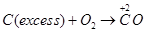
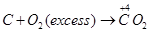
On the other hand, if C is burnt in an excess of O2, then CO2will be produced, wherein the O.N. of C is +4.
Not what you are looking for? Go ahead and submit the question, we will get back to you.